
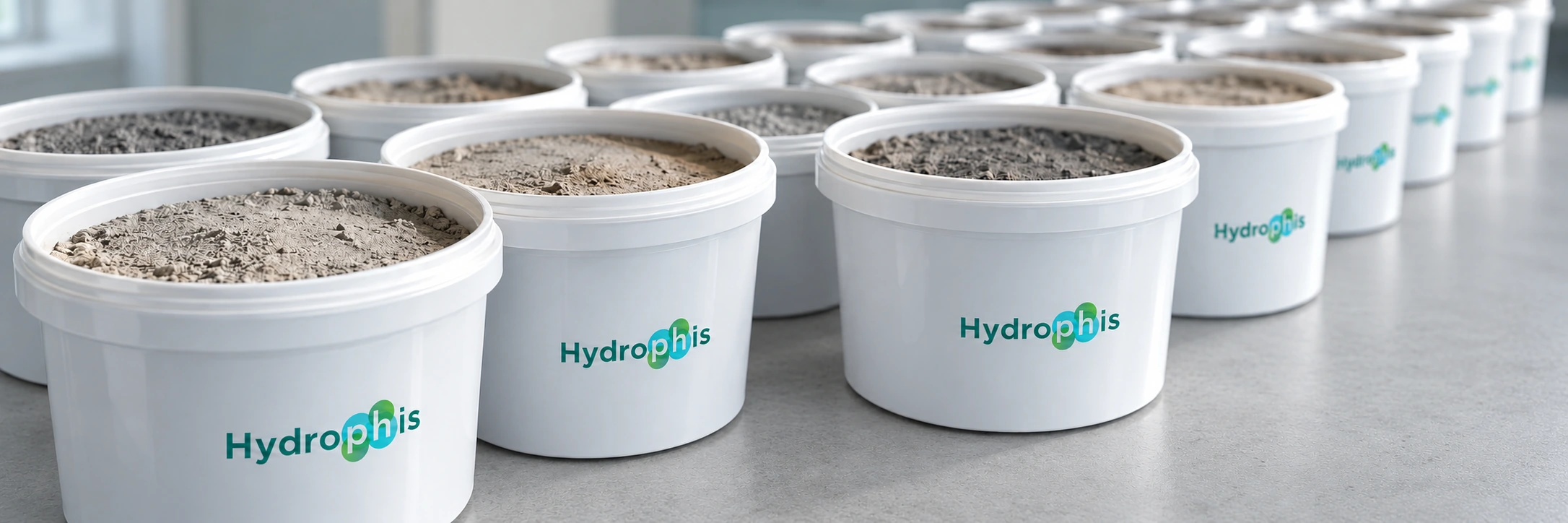
Reagent demand, product purity, reactivity and filtration behaviour are properties of the feed. The reagents for magnesium recovery vary significantly between seawater desalination brine and recirculated fly-ash rinse water. Trial-based data is required to identify the correct plant settings, potential product uses and market values.
We offer characterisation and resource estimation for both:
- Liquid streams: desalination brine, mine and process water, recirculated rinse liquors.
- Solid residues: legacy ash mounds and lagoons, tailings, slags and industrial mineral by-products.
We measure the material, report the phase rather than the element, and log the data.
Minerals
A product described as “91% magnesium” could be brucite, nesquehonite or hydromagnesite: three phases with different points of hydration, different decomposition temperatures, different handling requirements and materially different market values. We use Quantitative X-ray diffraction and other techniques to do the analysis, centring on phase, which is often controllable. We can produce aragonite, calcite, monohydrocalcite or magnesium-rich calcite from the same brine, for example, and we have deep chemistry experience at targeting the phase the offtake requires.
We match accreditation to material, not the laboratory
NATA or UKAS accreditation is specific to a method on a matrix. A laboratory accredited for sulphate in soils is not necessarily accredited for sulphate in fly ash. This often decides which laboratory is selected. We resolve accreditation scope against each laboratory's published schedule before award and allocate each analytical line to the lab with the strongest matrix coverage.
Proven at scale
Liquids. Six pilot campaigns between 2023 and 2026 on a 30 m³/day continuous rig at a working seawater desalination plant in South Australia, and on concentrated fly-ash rinse water.
Products recovered at pilot scale, measured by quantitative XRD on filter-press cake, purity by weight:
- Calcium carbonate 97%
- Magnesium hydroxide 98%
- Magnesium carbonate 99%
Solids. A Phase 1 chemical and physical characterisation of an 18 million tonne legacy pulverised fuel ash mound in Wales, commissioned by the site owner. Aberthaw, South Wales
Across both feed types the pattern is the same: the design settings come from measuring the actual material, not from published averages or past projects.
What we characterise
Liquids. Every liquid stream through the process is analysed for pH, conductivity, total dissolved solids, hardness, and alkalinity separated into hydroxide, carbonate and bicarbonate, plus calcium, magnesium, sodium, potassium, chloride, sulphate and fluoride. Heavy metals are tracked against the applicable regulatory standards.
Solids. Bulk and trace chemistry, including rare earths. Mineralogy by quantitative XRD, including the amorphous fraction that governs reactivity. Loss on ignition, moisture, sulphur and chloride. The physical and mechanical properties buyers need to know: fineness, activity index, water requirement, setting time, soundness and particle density. Leachate behaviour against applicable limits. Asbestos screening if the site history warrants it. We also undertake physical separation tests where a by-product fraction may be worth recovering.
Compliance testing
Composition and compliance are assessed separately. Construction end uses, bound and unbound, are governed by product standards that set limits on the requisite properties, e.g. activity index, water requirement, soundness and soluble chromium in leachate. We test against the standard that applies to the intended use, report each result against its limit, and suggest processing routes that would bring the material within specification.