
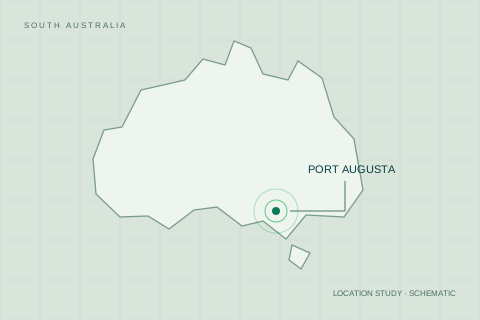
The site
Former Port Augusta power station, South Australia. The site holds a 20-million-tonne legacy fly ash deposit. Coal-fired generation has ended, and the ash will now be used as a raw material for regional cement and concrete markets.
The material
Historical seawater slurrying left the power station’s ash with elevated chloride levels. Washing the ash generates a chloride-rich rinse brine, which the Hydrophis process treats.
What we did
Hydrophis formed a 50/50 incorporated joint venture with Hallett Construction Materials https://hallett.com.au/ to deliver a full-scale commercial flagship plant (Plant #1) at the site. We designed the treatment train around our CO₂ pH-swing precipitation step, and the plant is scheduled to go live in mid-2027. The closed-loop system intercepts the high-chlorine rinse brine, softening and reclaiming it on-site. Phase 2 aims to remove the need for purchased freshwater altogether.
What came out
Phase 1 of the commercial-scale plant is designed for up to 210,000 tonnes of fly ash a year, sending up to 90,000 m³ of rinse water a year to the Hydrophis plant, which returns about 90% of it for reuse. It recovers calcium carbonate and magnesium hydroxide as separate saleable minerals. The process achieves near-complete softening of the water, driving residual calcium down to <10 mg/L and magnesium to <30 mg/L, which protects desalination membranes from scaling.
What it replaced
Without it, the salt-rich ash would stay stockpiled as a liability, and washing it conventionally would draw millions of litres of Murray-Darling river system freshwater in an arid region while generating large volumes of saline wastewater. The closed-loop system displaces almost all of the site’s purchased process water, reducing the site’s exposure to water tariffs and regional water scarcity. Concentrating the waste stream reduces the volume of brine sent to evaporation ponds. Regionally, the ash project replaces product currently imported from overseas and creates technical jobs for the community.
At a glance
- Site
- Former Port Augusta power station, South Australia
- Client / Partner
- Hallett Construction Materials (50/50 JV)
- Resource
- Approximately 20 million tonnes of legacy, high-chlorine fly ash
- Project Status
- Commercial flagship plant under construction, on schedule for commissioning in 2027
- Feed Rate
- 90,000 m³/yr of rinse water at 210,000 t/yr of fly ash
- Water Reclaimed
- 81,000 m³/yr of purchased potable supply displaced at 210,000 t/yr
- Minerals Recovered
- 190 tonnes per year of CaCO₃ and Mg(OH)₂ in the first phase